




(Version française) (Versión en español)
Xunan Ka’ab – The Sacred Bees of the Mayas
Inside the Hive
The moment the lid of the hive is removed, all our senses are immediately engaged. First, we see hundreds of bees in constant motion. Next comes a continuous, soft, and soothing hum, followed by the sweet aroma of honey, pollen, and wax. We then begin to observe the various distinct parts that make up the colony.

My friend, the biologist and botanist Jim Conrad, has been studying Mexican flora and fauna for several decades. I have had the pleasure of meeting him on a few occasions in the Yucatan, where he lived for many years. In one of his writings, he notes: "Charles Darwin was particularly struck by the fact that the combs of Melipona beecheii consist of round cells rather than hexagonal ones, as found in standard honey bees. He regarded the round cells of Melipona beecheii as an intermediate evolutionary stage between primitive bumblebees—which construct spherical structures and produce no honey—and honey bees with their hexagonal cells. Hexagonal cells allow bees to construct more cells while using less wax and expending less effort. For Darwin, these intermediate steps leading to hexagonal cells indicated that an instinct as complex as cell building in honey bees could evolve from simpler nest-building instincts."
The Brood (Reproduction Zone)
The brood cells are arranged in stacked horizontal layers connected by small pillars of cerumen. The structure often resembles that of a pyramid. Local legend has it that these bees inspired the ancient Mayas to build their pyramids—who knows!
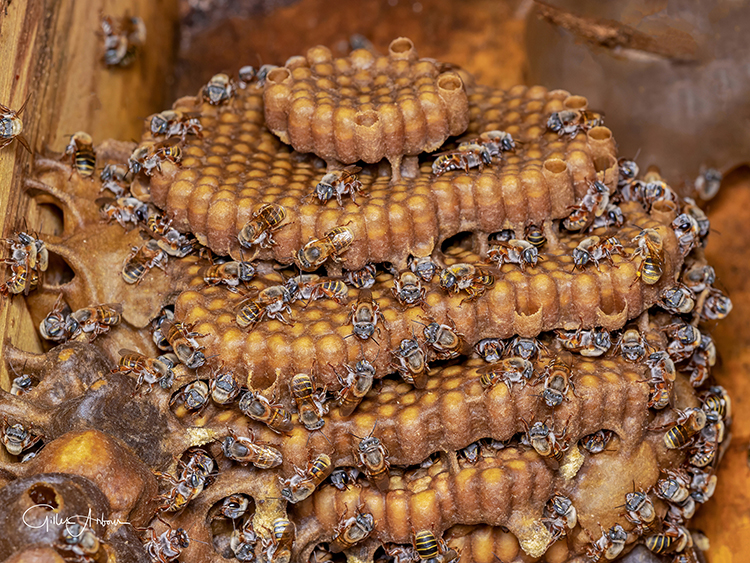
A network of small cerumen pillars supports each tier of the structure, while the involucrum—a thin protective envelope composed of several layers of cerumen—completely surrounds the brood area. Its purpose is to protect the developing larvae by maintaining a stable temperature around 30 °C (86 °F). Hive thermoregulation is vital, which is one reason why caretakers try to keep the hive tightly sealed to avoid disturbing the brood.


Storage Areas (Honey and Pollen)
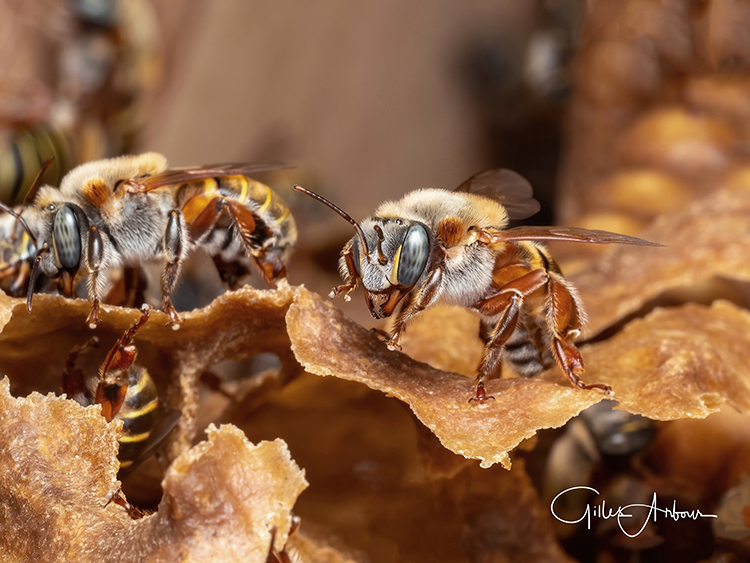
Storage Pots: Honey and fermented pollen are not stored in the same section as the brood. Instead, the bees mold egg-shaped cerumen pots ranging in size from a small plum to a lemon. These pots are clustered along the periphery of the brood area.


Resin Storage
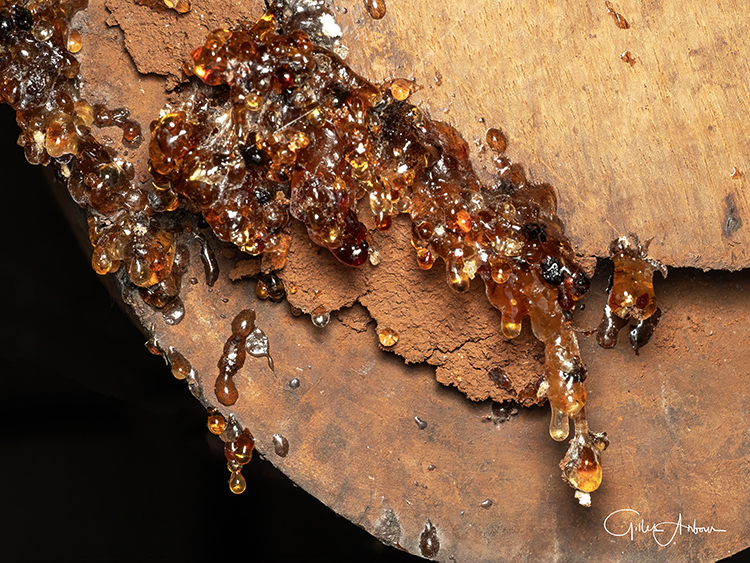
Bees of the tribe Meliponini (stingless bees) do not store collected plant resin inside pots. Instead, they accumulate it on the inner walls of the hive, particularly in the corners.
These large deposits of resin, gathered from various plant species, remain easily accessible. Workers use this raw material to synthesize cerumen (beeswax mixed with resin) required to construct honey and pollen pots, the involucrum, and all internal structures including brood cells.
Resin also serves a crucial defensive function. Bees can use sticky resin to attack and immobilize intruders, such as phorid flies, before they can cause damage or lay eggs. Additionally, resin offers chemical protection against much smaller enemies like bacteria, viruses, and fungi. In nature, plants secrete resin within specialized cells as a defense mechanism against microbial invasion. The resin collected by the bees serves to line the interior hive walls, creating an antimicrobial barrier throughout the nest.
Furthermore, bees use resin to formulate geopropolis (a mixture of wax, resin, and mud or clay) to seal any gaps where the hive components meet, ensuring structural weatherproofing. Micro-fissures are always present in both traditional and modern wooden hives. The bees apply geopropolis into every corner and across wall surfaces to prevent moisture loss from the brood chamber and to waterproof the wooden structure against external rainwater infiltration. Technically, this protective perimeter constructed from geopropolis is called the "batumen," though the term is rarely used in practice.
What Does Resin Color Tell Us?
The appearance of resin deposits varies depending on surrounding floral sources. Fresh deposits are glossy and amber, bright yellow, reddish-brown, or translucent. Older deposits turn dark brown or black, becoming hard and brittle as volatile terpenes evaporate over time. Geopropolis deposits, on the other hand, are very dark, matte, hard, and brittle. Generally, a heavy accumulation of resin along the hive walls is a strong indicator of a healthy colony.


In this video, César Antonio Kuyoc, local coordinator of the Mayan Melipona Bee Sanctuary Project, is seen breaking through geopropolis deposits to access honey pots inside a jobón (traditional log hive). The extracted geopropolis is used to prepare a medicinal propolis tincture. Meliponary Don Pastor Dzul y Dzul, Tahmuy, Yucatán, Mexico.
Nest Variations Between Species
Bees belonging to the tribe Meliponini, such as Melipona beecheii, each construct distinct nest architectures. There are 46 species of Meliponini in Mexico, with 16 to 19 present in the Yucatan Peninsula. While not all have the same economic importance, each fulfills a vital ecological role.
What is a Tribe?
In biological taxonomy, species such as Melipona beecheii are classified within a hierarchy ranging from broad kingdoms down to the species level, where the binomial name combines the genus (Melipona) and the specific epithet (beecheii). The "tribe" rank sits between the subfamily (Apinae) and the genus (Melipona). Consequently, all members of the tribe Meliponini belong to Apinae, though not all belong to the genus Melipona. Other genera within this subfamily include Trigona and Plebeia.
Taxonomic Position of Melipona beecheii:
- Animalia – Animals
- Arthropoda – Arthropods
- Insecta – Insects
- Hymenoptera – Hymenopterans
- Apidae – Bees
- Apinae
- ➡️ MELIPONINI — STINGLESS BEE TRIBE
- Melipona – Melipones
- Melipona beecheii
- Melipona – Melipones
- ➡️ MELIPONINI — STINGLESS BEE TRIBE
- Apinae
- Apidae – Bees
- Hymenoptera – Hymenopterans
- Insecta – Insects
- Arthropoda – Arthropods
In everyday language, rather than referring to the tribe Meliponini, people simply say "stingless bees." These bees retain only a vestigial trace of a stinger that can no longer sting. I will discuss other members of this tribe present in the Yucatan in a future article.
Consulted References
- Mayan Melipona Bee Sanctuary Project: mayanmeliponabee.org
- Photo Exhibition: Flickr Album
- Backyard Nature: Jim Conrad (backyardnature.net)
- Nature Web Nomenclature: natureweb.com
- Stingless Bees of Mexico, Springer 2018, José Javier G. Quezada-Euán..
- Handling sticky resin by stingless bees (Revista Brasileira de Entomologia).
- Palynology as a Tool to Distinguish between Propolis and Geopropolis (ResearchGate).
- Shanahan & Spivak (2021), Resin Use by Stingless Bees: A Review, MDPI / PMC.
- Bajaree Chuttong, Kaiyang Lim. et al (2023) Exploring the Functional Properties of Propolis, Geopropolis, and Cerumen, with a Special Emphasis on Their Antimicrobial Effects
- Felix Zulhendri, Kavita Chandrasekaran, et al (2021) Antiviral, Antibacterial, Antifungal, and Antiparasitic Properties of Propolis: A Review
- David Roubik Smithsonian Institution Stingless bee nesting biology
Header Photo: Meliponary Mayan Melipona Bee Sanctuary Project. Valladolid, Yucatán, Mexico.


