




(Version française) (Versión en español)
Xunan Ka’ab – The Sacred Bees of the Mayas
The Guardian
The guardian at the hive entrance is our primary contact with a colony of Melipona beecheii bees. Constantly present, she allows members of her community to enter while blocking access to outsiders. She also keeps predators at bay, such as ants or phorid flies. Generally, our observation of the hive is limited to watching the back-and-forth movement of bees departing or returning under the attentive gaze of the guardian. Because opening the hive leaves the population vulnerable, it is done only out of necessity—to harvest honey, for instance, or to perform maintenance. The rest of the time, the hive must remain tightly sealed.
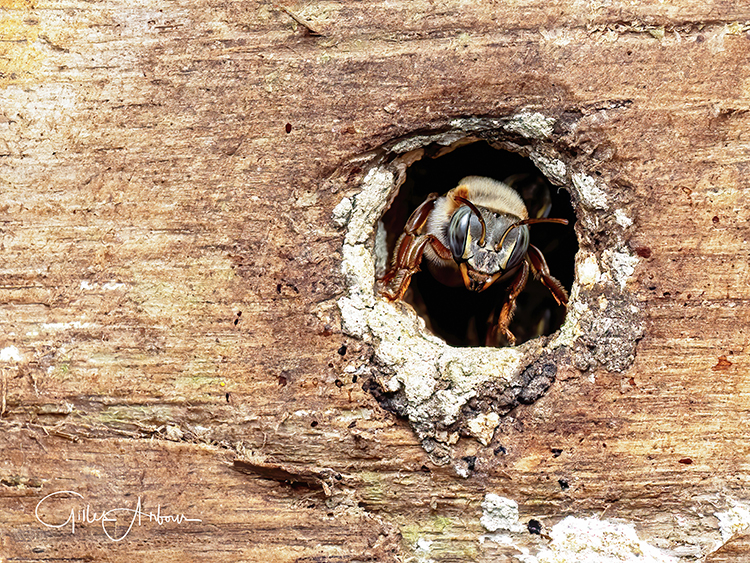
The Guardian is in no way physically different from other workers; only her role changes. The worker that becomes a guardian is usually middle-aged, serving as a transition between the internal tasks performed by younger bees and the foraging of nectar, resin, and pollen conducted outdoors by older bees.
Age-Related Polyethism: How Bees Change Roles as They Age
The average total lifespan of a worker is approximately 52 days. In Melipona beecheii, workers typically become guardians at the hive entrance when they reach 25 to 35 days of age. This task is part of a natural behavioral progression tied to the bee's aging process, known as "age-related polyethism," which shifts worker activity from inside the hive toward the outside. Worker behavioral development can be broken down into three stages:
- From emergence to 25 days: Workers perform internal duties such as cleaning, wax production, building brood cells, producing trophic eggs to feed the queen, and processing nectar into honey.
- Between 25 and 35 days: They take on the role of guardians. It is also during this period that they begin venturing outside the hive for short distances on orientation flights, learning the visual landmarks surrounding the hive.
- After 35 days: Workers enter their final active phase, becoming foragers that collect nectar, pollen, and resin.
However, all these roles are flexible. If necessary, a bee can revert to internal hive duties as needed. Variations occur depending on the needs of the community.
The Hive Entrance
Around the entrance where the guardian stands, deposits of resin can be observed. These are believed to serve several functions. For example, they create a specific pattern that bees of the colony recognize from a distance; they fly straight to it without hesitation, even when surrounded by other very similar hives. Resin residues also act as a repellent against ants, and especially against bacteria and other microorganisms that could infect the colony. While some stingless bee species are known to use resin to immobilize intruders, I have never observed this behavior in M. beecheii.
In other stingless bee species, the guardian is visibly more robust, but in Melipona beecheii, she is identical to other workers. This is clearly visible in the following photograph: the guardian is on the left and the worker on the right, yet they are identical.
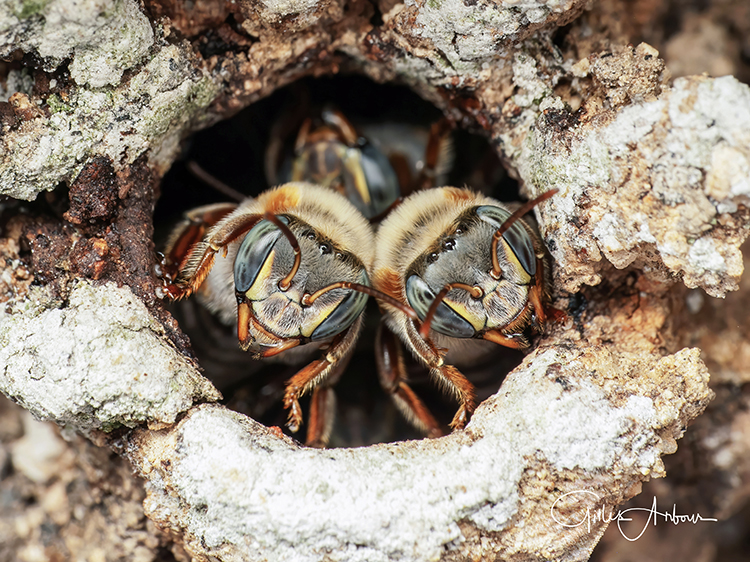
An interesting observation I made at the meliponary of the Mayan Melipona Bee Sanctuary Project in Valladolid: we had to move a jobón (traditional log hive made from a hollow tree trunk) from one spot to another within the meliponary, thereby altering the angle of light reflection on the entrance. Afterwards, I watched workers continuously busy at work reshaping the entrance. My hypothesis was that the entrance needed prompt modification so returning foragers could quickly regain their visual cues. Several workers spent two days reshaping and repositioning these zones. I also noticed that each colony displays a distinct pattern around the entrance hole. I believe the way these patterns reflect light helps foragers spot their own colony as they return home.
Further research made my hypothesis even more plausible. With their compound eyes, the bees perceived a shift in their visual signature, causing drift or hesitation among returning workers. This is why the workers in charge of the entrance rushed to reshape the patches of white clay and resin—to restore maximum contrast and adapt to the new lighting angle. Redesigning the entrance successfully restored the visual signal, ensuring that foragers returning at high speeds could instantly identify their nest entrance without losing a second.

Foragers initially rely on a macro-view (trees, other jobones or hives, rooflines) and sunlight to navigate back to the general area of the meliponary. Once they reach the front of the hives, visual contrast takes over. Bees depend heavily on high visual contrast—specifically dark centers surrounded by lighter, textured, radiating patterns—to zero in on the precise entrance hole. The unique radial structures around the entrance are not merely random decorations; they are visual landmarks designed for this exact purpose.

In addition to visual patterns, workers line the entrance with geopropolis (a mud mixture composed of clay, plant resin, wax, and other bee secretions) and nest-marking pheromones. Returning foragers use these olfactory signatures to confirm they are at the threshold of the correct hive, where they will be welcomed with their haul.
A Bit of Chemistry
The guardian bears a major responsibility: she is tasked with letting returning bees in, letting departing bees out, and preventing intruders from entering the hive. Thus, she must distinguish between colony members and potential intruders. How does she tell them apart? A bee's chemical footprint consists of a complex, waxy outer layer made of long-chain alkanes, alkenes, and methyl-branched hydrocarbons. These are simply organic compounds present on the insect's cuticle or exoskeleton. This protective layer acts as a waterproof shield against dehydration and doubles as a chemical "ID card," indicating nestmates, caste, age, and genetic lineage.
Each bee possesses her own chemical signature, which changes with age but remains very close to that of the guardian from her own hive compared to members of another colony. This similarity, perceived by the guardian, enables her to quickly determine who may enter. Guardian bees detect these specific chemical components to distinguish strangers from colony members. Scientific literature suggests that it may actually be the absence of certain compounds that is used to recognize an intruder.

Entries and Exits
Melipona beecheii are meticulous masons, constantly adjusting the entrance diameter so that it remains just wide enough for a single worker to pass through, while keeping larger threats out. When a returning forager arrives laden with nectar, pollen, or resin, the guardian on duty steps back inside the tunnel to let her pass. Once the worker is inside, the guardian—or the next bee in line—returns to her position to block the opening. If a threat approaches (such as cleptoparasitic bees or ants), the primary sentry uses her head and body to physically block the entrance while releasing alarm pheromones to summon reinforcements from behind her.
The guardian observed at the entrance is not the only one filling this role; she is periodically replaced by another guardian. While other species of the tribe Meliponini may keep 10 or 15 guardians at the entrance, M. beecheii relies on just one. In M. beecheii, guarding is a dynamic shift rather than a lifelong assignment. Guardians work shifts ranging from a few minutes to a few hours before relinquishing the post to another worker inside the hive.

Risk Management
Why assign mature workers to guardian duty? Positioning older workers at the entrance minimizes risks to the colony. Because guarding carries a high risk of injury or predation, the colony deploys older, experienced workers that have already fulfilled their indoor responsibilities, rather than endangering younger bees.
The hazards faced by the guardian and by foragers working outdoors are far greater than those encountered by bees performing indoor duties. The loss of an older worker, who has already made a significant contribution to the colony, is less detrimental to the overall survival of the group than losing a young bee.
At all times, a bee stands guardian before the single entrance hole of the hive. The survival of the entire colony hinges on her vigilance. One might think her role is unproductive since she does not forage, build structures, or feed the queen or her nestmates. In truth, her role is vital. Without the guardian, the hive would instantly become vulnerable and quickly perish.

___________________________
References Consulted for This Article
- Genesis Eco Oasis: genesisecooasis.com
- Mayan Melipona Bee Sanctuary Project: mayanmeliponabee.org
- Photo Exhibition: Flickr Album
- Stingless Bees of Mexico, Springer 2018, José Javier G. Quezada-Euán.
- Waste Management in the Stingless Bee Melipona beecheii Bennett (Hymenoptera: Apidae)
Header Photo: The Guardian. Meliponary Colectivo Tu luʼumil kool tak ta kʼóoben (Coop Familiale Alfredo Hau). Chichimilá, Yucatán, Mexico.


